
.jpg)
In 2026, the question for global enterprises is no longer about the speed of AI, but the defensibility of its output. As Generative AI flattens the cost of translation, it simultaneously inflates the cost of error. For a Chief Risk Officer (CRO) or General Counsel, an unverified AI "hallucination" in a medical dosage instruction or a $10M procurement contract isn't just a quality issue—it’s a trigger for multimillion-dollar litigation and intense regulatory scrutiny.
This model is increasingly adopted by enterprise organizations to align localization decisions with compliance, governance, and financial risk exposure. To scale globally without exposing the organization to catastrophic failure, leaders must pivot from "translation as a service" to Linguistic Liability Management.
What is Risk-Based Localization?
Risk-based localization is a strategic governance framework that assigns the appropriate translation method—Human, AI, or Machine Translation (MT)—based on the potential impact of an error. It categorizes content through three critical dimensions: Visibility (audience size), Risk (legal/safety consequences), and Durability (active lifespan of the asset)
The Governance Gap: Why Accuracy is Not Enough
Traditional localization focused on "fluency." In the enterprise B2B sector, fluency is secondary to Accountability. If an automated system provides a flawed translation of an Individualized Education Program (IEP) or a medical record, "the algorithm made a mistake" is not a defensible legal argument.
Understanding the difference between localization and globalization is crucial here: while globalization prepares your product for the world, localization manages the specific cultural and legal risks of each market.
The Enterprise Localization Decision Matrix: 3 Key Factors That Drive Strategy
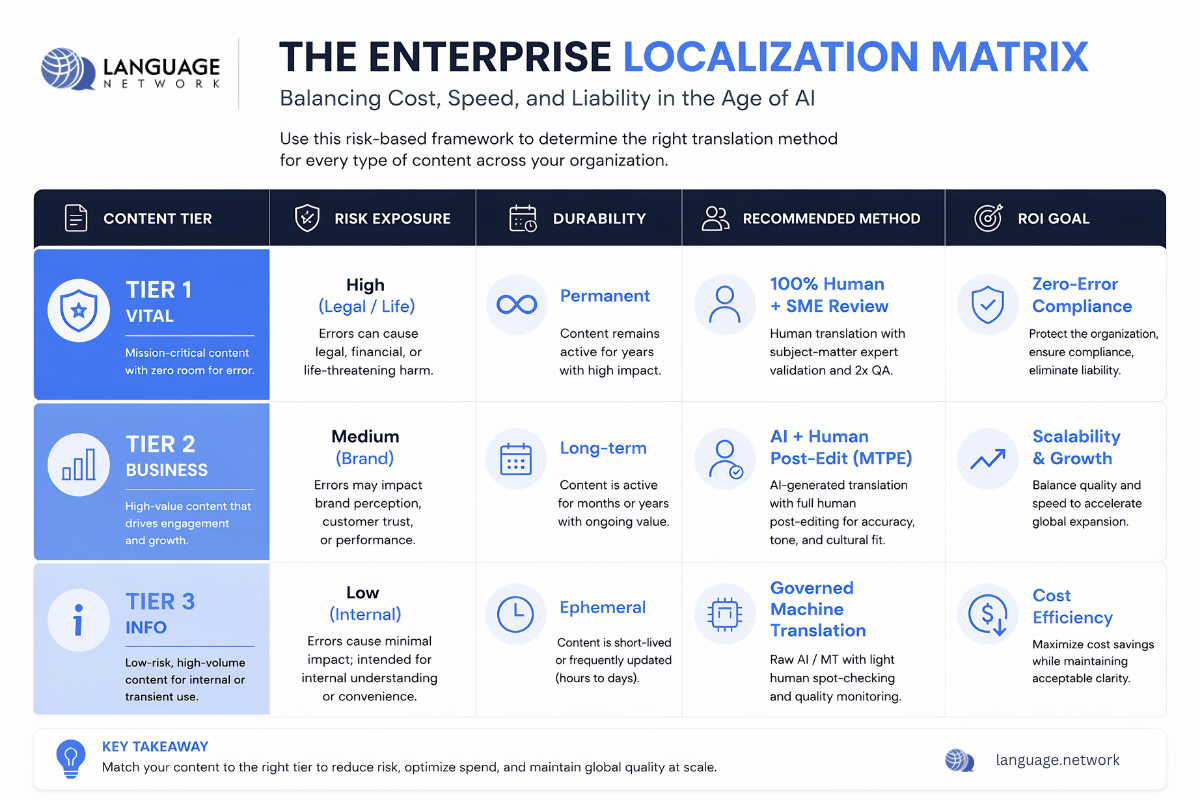
As shown in the matrix, content is categorized into three distinct tiers based on its Risk, Visibility, and Durability. By identifying where your high-value assets lie, your team can implement scalable workflows that guarantee compliance where it matters most, while optimizing spend on lower-stakes content
Can AI Translation Be Legally Compliant? The Cost of Getting It Wrong
For the General Counsel, the primary concern is liability exposure. Using public AI tools for sensitive content is not just inefficient—it is a potential data governance violation that could lead to a permanent breach of intellectual property.
Healthcare and Patient Safety
According to HHS Section 1557 guidance on language access, healthcare providers must ensure meaningful access for LEP (Limited English Proficient) individuals. Relying on ungoverned AI for patient-facing clinical data or pharmacy instructions is a direct violation of federal civil rights, exposing the organization to systemic audits.
To mitigate these risks, our medical localization services ensure that all Tier 1 assets undergo rigorous subject-matter expert validation.
Government and Legal Accountability
Whether managing government localization services or complex litigation, the ADA Compliance and Section 508 standards are absolute. If a localized educational portal fails to meet these requirements, the institution faces immediate administrative hearings and loss of federal funding.
Don't leave your marketing content localization to chance; brand perception is hard to build but easy to destroy through a single culturally insensitive AI error.
The "Durability" Factor: The Hidden Driver of ROI
Most managers ignore Durability when budgeting, which leads to massive over-investment in temporary content and dangerous under-investment in legacy assets.
- Disposable Content (Short Shelf-Life): A daily Slack update or a social media post lives for 24 hours. The risk of an error is low-impact.
- Legacy Content (Long Shelf-Life): A technical manual or a corporate bylaw lives for 10 years. An error in these documents is cumulative; it accumulates risk and potential liability every single day it is published.
By understanding localization and globalization in marketing, leaders can better allocate resources where they truly impact the bottom line. Treating a medical manual that stays active for a decade with the same rigor as a 24-hour tweet is not a "saving"—it is strategic negligence.
Enterprise Translation Risk Management: 2026 Strategy
Education: Equity and Language Access
For school districts, localization is a civil rights requirement. Under the Individuals with Disabilities Education Act (IDEA), providing a flawed AI translation of a child's IEP is a breach of federal law.
Our website localization services prioritize accessibility and legal defensibility for all public-facing platforms.
Fast, Cost-Effective, and Legally Defensible
The growth we tracked in 2025—including a 45.3% increase in high-intent organic traffic—confirms that enterprise leaders are no longer looking for "translation vendors." They are looking for Risk Mitigation Partners.
Most enterprises discover that 30–50% of their content is incorrectly categorized—either over-invested or dangerously under-controlled. At Language Network, we help you build an AI-powered engine that is governed by human intelligence, ensuring your global expansion is fast, cost-effective, and legally defensible in high-risk environments.
🎯 Take the Next Step in Your Governance Strategy
Don't leave your global reputation to an ungoverned algorithm.
Evaluate your content risk profile now!