
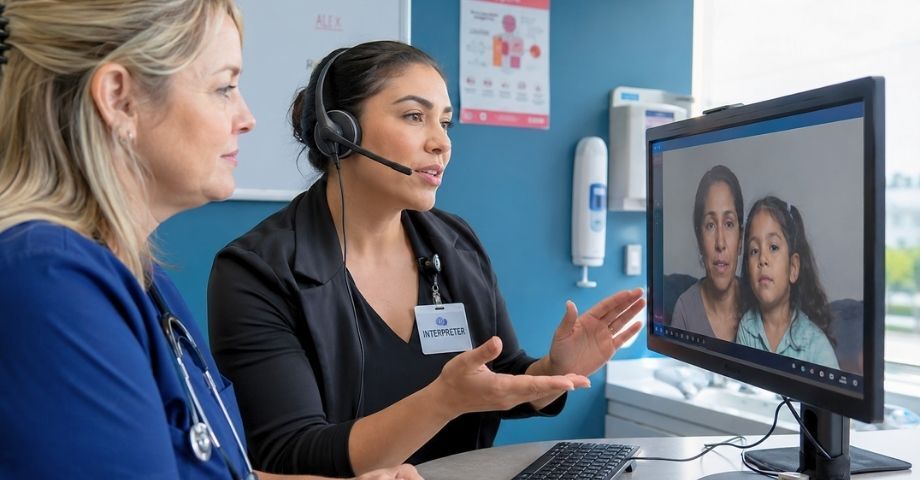
For health systems in rapidly diversifying hubs like Houston, Austin, and Los Angeles, the challenge is no longer launching telehealth; it is ensuring that virtual care for 25M+ LEP patients meets the same clinical standards as in-person encounters. As virtual care becomes a permanent pillar of US healthcare delivery, hospital administrators face a critical decision: how to scale telehealth interpretation without compromising patient safety or falling foul of federal oversight.
The solution lies in a human-centered hybrid infrastructure—a model that leverages technology for workflow efficiency while reserving certified human expertise for high-stakes clinical decision-making.
Executive Summary: The Evolution of Virtual Care Infrastructure
As health systems in major hubs like Houston and Los Angeles scale their virtual offerings, telehealth interpretation has transitioned from a temporary pandemic solution to a permanent, high-stakes infrastructure requirement.
The future of medical compliance lies in a human-centered hybrid model: leveraging AI for administrative workflows while ensuring professional linguists handle every clinical encounter to mitigate misdiagnosis risks and Section 1557 violations.
Strategic Risk: Relying on unverified machine translation for patient intake or discharge instructions triggers federal ADA non-compliance and increases medical malpractice exposure.
1. The Cost of Linguistic Friction in Virtual Care
While "commodity" video platforms offer basic connectivity, they often fail to address the clinical nuances required for medical accuracy. According to research on communication barriers and patient safety, linguistic friction is a leading indicator of medical errors and readmission rates.
In a telehealth environment, the lack of physical presence makes the role of a certified medical interpreter even more vital. Administrators must move beyond viewing interpretation as a "utility" and start viewing it as a malpractice mitigation tool. Under Section 1557 and ADA guidelines, providing auxiliary aids is not optional; it is a prerequisite for maintaining federal funding and ensuring health equity in US healthcare.
2. Decision Matrix: AI vs. Human Interpretation
To optimize budgets, procurement officers must triage clinical workflows based on risk. While AI can handle administrative intake, clinical diagnosis requires a human-in-the-loop.
| Clinical Workflow | AI Utilization Risk | Recommended Modality |
|---|---|---|
| Patient Intake / Registration | MODERATE | OPI or Hybrid AI for administrative data entry with professional human oversight. |
| Diagnosis & Informed Consent | CRITICAL | Certified medical interpreters (VRI or On-site) are mandatory for legal validity. |
| Discharge Instructions | CRITICAL | Professional human interpretation to ensure medication adherence and ADA compliance. |
3. Solving the "Last Mile" of Access in Texas and California
Health systems in the Southwest face unique linguistic densities. Houston, for instance, requires deep expertise in Vietnamese and Spanish, while Los Angeles necessitates a robust network for Indigenous and Asian languages. A generic national vendor often lacks the local remote-hybrid interpreting infrastructure to provide high fill rates during regional peak hours.
Furthermore, as the 119th Congress reviews new accessibility mandates, hospitals must ensure their vendors provide real-time credential validation. This is particularly crucial for ASL telehealth compliance, where certified proficiency is the only way to meet "Effective Communication" standards.
4. Procurement Readiness: Auditing for the Future
When evaluating a partner for over-the-phone (OPI) or video services, administrators should look beyond the per-minute rate. A provider’s value is found in their Audit Readiness—their ability to provide time-stamped logs and QA reports that simplify Section 1557 reporting.
Telehealth Partner Audit Checklist
Use this interactive tool to evaluate your telehealth language infrastructure against federal mandates.
Eliminating patient backlogs with instant access to certified medical interpreters during peak hours.
Sub-30 second VRI and OPI connections to minimize physician "click fatigue" and wait times.
Automated PHI-secure encounter logs for Section 1557 and Joint Commission reporting.
5. Metrics that Matter: ROI in Language Access
Effective language access isn't just a cost center; it's a performance driver. By reducing "click fatigue" for physicians and ensuring patients understand their discharge instructions, hospitals can see a direct impact on their HCAHPS scores and Value-Based Care incentives.
Engineering Equity into Telehealth
True innovation in healthcare is not defined by the complexity of the software, but by the accessibility of the outcome. For administrators in Texas and California, the hybrid future offers a path to scale virtual care responsibly. By integrating certified human interpreters into a seamless digital workflow, agencies can protect their patients, their providers, and their bottom line.
Ready to Future-Proof Your Telehealth Infrastructure?
Optimize your clinical workflows and ensure 100% compliance with Section 1557 and ADA mandates through our hybrid interpretation model.
Or click here to Schedule a Consultation to review your HCAHPS improvement plan and secure telehealth protocols.
FAQ: Telehealth Interpretation & Medical Compliance
How does Section 1557 of the ACA impact telehealth providers?
It requires health programs receiving federal support to provide "meaningful access" to patients with limited English proficiency. In telehealth, this means ensuring that language support is clear, accurate, and easily available during virtual consultations.
Is the VRI infrastructure secure for patient privacy?
Yes. As your language access partner, we ensure all virtual encounters are protected by industry-standard encryption and formal privacy agreements. Our systems are designed to keep patient information secure and confidential at every step.
Can a hybrid model improve patient satisfaction scores?
Absolutely. When patients can communicate clearly with their doctors, they feel more confident in their care. This leads to better adherence to medical advice and a significant boost in overall satisfaction and hospital experience.
About Language Network
Language Network is a language solutions company specializing in interpretation, translation, and localization services for government, healthcare, and international businesses. Language Network provides critical language access and support in over 200 languages. For more information, visit www.language.network.