Executive Summary:
When a prominent California children’s museum prepared for its grand reopening, leadership faced a critical accessibility challenge: transforming a highly creative, interactive magnetic poetry wall into an equitable bilingual experience. Discover how Language Network utilized specialized literary translators and a structured workflow to deliver ready-to-use Spanish translation services ahead of schedule.
Key Takeaways
- Fluency vs. Skill: Bilingual fluency alone does not qualify internal staff to handle specialized creative or educational translation.
- The Transcreation Factor: Interactive exhibits require cultural adaptation to preserve their original playful intent and educational value.
- Audience Alignment: Children's educational content demands a deep understanding of developmental language bounds and age-appropriate vocabulary.
- Operational Efficiency: Delivering ready-to-use formatting reduces the technical workload for internal graphic design and installation teams.
Quick Answers
- Why should museums use professional translation services? Museums use professional translation to create consistent, culturally appropriate multilingual experiences. Professional linguists preserve the playful, educational intent of the copy, which automated tools or unvetted staff often destroy through literal translations.
- What are the risks of relying on bilingual staff? Relying on bilingual staff pulled from other departments causes operational bottlenecks during tight project deadlines. Additionally, everyday conversation skills do not equip an employee to navigate complex linguistic challenges like wordplay or child-centered copy.
- How does professional translation improve accessibility? Professional translation removes communication barriers, creating an inclusive experience for non-English speaking families. It helps cultural institutions build community trust, welcome wider local demographics, and deliver their educational mission equitably.
Quick Overview
The following summary table outlines the core operational parameters of this educational translation project:
Why Creative Translation Matters in Museums
Museums are no longer just repositories of history; they are dynamic spaces designed to spark curiosity, education, and community engagement. When cultural institutions expand their exhibits to welcome multilingual audiences, standard word-for-word translation often falls short. Interactive displays, educational prompts, and artistic signage rely heavily on tone, wordplay, and cultural context to engage visitors effectively.
Creative translation—or transcreation—adapts the core message and playful intent of the original text so it resonates naturally with diverse communities. By moving beyond literal translation, museums can prevent confusing phrasing, maintain pedagogical value for young learners, and build authentic local trust. Investing in specialized linguistic adaptation ensures that every visitor, regardless of their native language, experiences the exhibit exactly as the curators intended.
The Challenge: Monolingual Barriers and the Risks of Internal Staff Workflows
The Museum, an educational institution dedicated to cultivating curiosity and community engagement, faced a major operational hurdle during its reopening preparations. In this case, the administrative team aimed to create an inclusive environment for the region's diverse population. According to demographic research from the Migration Policy Institute, providing accessible multilingual communication is a vital step for community-facing organizations looking to establish real local trust and ensure language accessibility.
Previously, the museum had managed its translation workflows internally, relying on bilingual staff members to translate various operational documents into Spanish. While these employees possessed conversational fluency, a highly creative and artistic exhibit pushed the boundaries of internal translation capabilities.
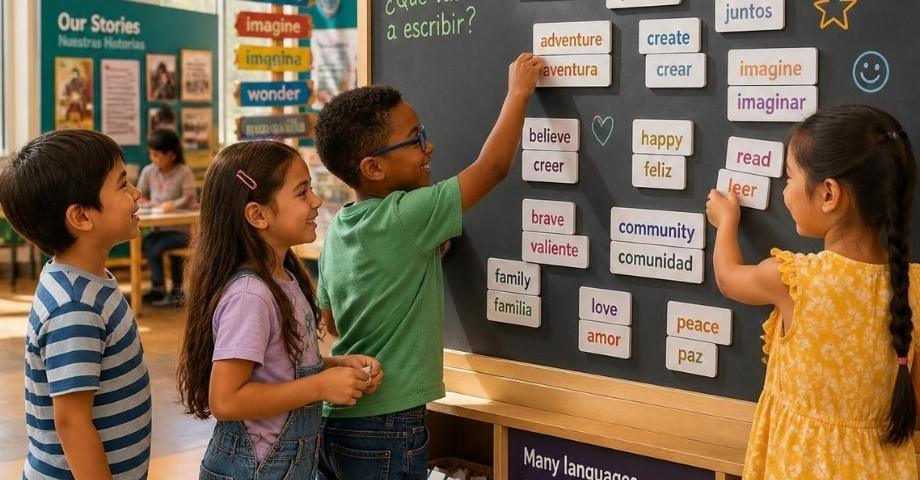
The specific assignment involved a magnetic poetry wall designed for children. The museum needed to translate a comprehensive list of isolated words, phrases, and prompts that young visitors would physically manipulate to construct their own sentences.
The team quickly realized that this specific deliverable introduced significant linguistic complexity. In everyday prose, words rely on surrounding context to clarify their meaning. On a magnetic poetry wall, individual words stand alone and must remain flexible enough to make sense in dozens of different sentence combinations. A single English word could function as a noun, a verb, or an adjective depending on how a child chooses to place it. Relying on an internal bilingual staff workflow for this task introduced a severe business challenge: everyday speakers lack the deep training needed to choose Spanish terms that preserve this level of grammatical flexibility.
Why This Project Was Different: The Art of Creative Translation for Children
Translating an interactive children's exhibit requires a completely different approach than translating standard corporate documents. Standard administrative workflows prioritize literal accuracy and rigid terminology consistency. However, translating interactive children's content is significantly more complex due to the need for emotional resonance, pedagogical alignment, and artistic flexibility.
This project demanded advanced literary expertise and transcreation—the process of adapting a message from one language to another while maintaining its original intent, style, tone, and emotional impact. The magnetic words weren't just data points; they were tools for creative expression. Professional translation helps organizations create more consistent and culturally appropriate multilingual experiences, which is crucial when dealing with child-centered interactive environments.
Our linguists had to ensure that the Spanish words selected had matching semantic variations that allowed children to explore different meanings. The target vocabulary needed to be accessible to young learners across various age groups, yet engaging enough to encourage collaborative learning with the parents reading alongside them. The project required careful linguistic decisions because many of the words needed to work in multiple sentence combinations. Every single word on that magnetic wall had to be vetted to ensure that a Spanish-speaking child could experience the exact same cognitive milestones, playful exploration, and linguistic discovery as an English-speaking peer.
Language Network’s Approach: Step-by-Step Translation Workflow
To execute this creative translation assignment within the museum’s tight reopening timeline, Language Network deployed a structured, four-step language access workflow designed to secure contextual flexibility and preserve the exhibit's educational spirit:
The Solution: Seamless, Design-Ready Bilingual Deliverables
Language Network provided a highly creative, thoughtful translation solution tailored exactly to the operational needs of the CDMOD. Recognizing that the museum's internal marketing and production teams were responsible for the physical formatting and design of the wall, we eliminated administrative friction during implementation.
Since the client was handling the formatting and design on their end, we provided a clean bilingual Word document imitating the original format so it was easier for the client's team to then copy and paste it into their desired layout. This precise layout eliminated guesswork for the museum's graphic designers. Even if the production staff did not speak Spanish, they could place the text onto the signage panels without formatting mistakes.
Results: Achieving Inclusion and Improved Accessibility
By partnering with Language Network, the museum achieved several important qualitative and operational results:
- Improved Accessibility : The institution eliminated an invisible communication barrier, ensuring that Spanish-speaking families could access the interactive poetry wall with the same depth of engagement as English-speaking visitors.
- Smoother Reopening: Confirming the best resources and expediting the delivery allowed the museum to finalize exhibit fabrication without last-minute production stress or operational bottlenecks.
- Optimized Visitor Experience: We provided a creative approach for the translation of this project, and it was exactly what the client needed. Children interacted with the bilingual poetry wall naturally, maximizing the exhibit’s educational impact.
- Easier Design Implementation: The clean, side-by-side bilingual formatting minimized errors during design integration, saving the museum money on costly layout re-works.
- Reduced Internal Workload: The museum's executive team protected its staff from the burdens of manual translation management, allowing internal resources to focus entirely on launch day curation and guest relations.
Client Feedback
The structured methodology, speed of delivery, and professional execution provided by our educational translation team earned definitive praise from the museum’s executive leadership. The Chief Executive Officer of the Museum, highlighted the direct impact of this collaboration:
"Thank you so much for this. I truly appreciate your work. You are helping make the Museum more accessible."
The Chief Executive Officer later added:
"Thank you so very much for being expedient and so professional."
Why This Story Matters for Other Museums and Educational Institutions
This customer success story highlights a critical lesson for museum directors, communication managers, and nonprofit leaders across the country. Creating inclusive multilingual communication is a vital component of successful community engagement. We demonstrated accessibility, thoughtfulness, creativity, and willingness to look for the best approach for the project.
When cultural institutions leave their interactive exhibits or educational signage exclusively in English, they unintentionally exclude a vast portion of local neighborhoods. Choosing professional translation services allows organizations to build deep, lasting trust with diverse families, expand their member demographics, and maximize their educational impact. If you are developing wider programs for the public sector, learn more about organizing your resources in our guide on Optimizing Public Sector Interpreting Access.
Lessons Learned for Exhibit Planners
When coordinating language accessibility for upcoming public exhibits, administrative teams should incorporate these key operational takeaways:
- Don't Rely Solely on Bilingual Employees: Fluency in everyday speech does not replace professional localization skills. Protect your staff's working hours and your brand's reputation by utilizing certified translators.
- Choose Translators with Deep Subject-Matter Expertise: A general document translator often struggles when processing interactive or child-focused copy. Always partner with linguists who have a documented background in early childhood education or creative text. To understand how structured language access scales across larger administrative pipelines, review our guide on Scaling K-12 Language Equity.
- Consider Cultural Adaptation from the Beginning: Language equity must be woven into the initial exhibit curation process rather than patched on during final production. Designing side-by-side bilingual layouts early prevents costly physical sign fabrication mistakes.
Professional Translation vs. Internal Bilingual Staff
The comparison table below details the systemic operational risks of relying on unvetted staff versus partnering with a professional translation agency: