A single communication breakdown on an assembly line can halt a shift for hours. For plant directors in manufacturing hubs like Seattle, coordinating daily production targets is already a high-stress job. When a significant portion of the workforce has Limited English Proficiency (LEP), managing team safety and baseline efficiency requires a structured approach.
According to data from the U.S. Bureau of Labor Statistics, foreign-born workers make up over 18% of the domestic labor force, driving core production lines nationwide. Yet, many plants still manage language barriers using informal, ad-hoc methods. Pulling a bilingual supervisor away from their station to translate a safety briefing might seem like a quick fix, but it backfires during tight production deadlines.
What Is an Industrial On-Site Interpreter?
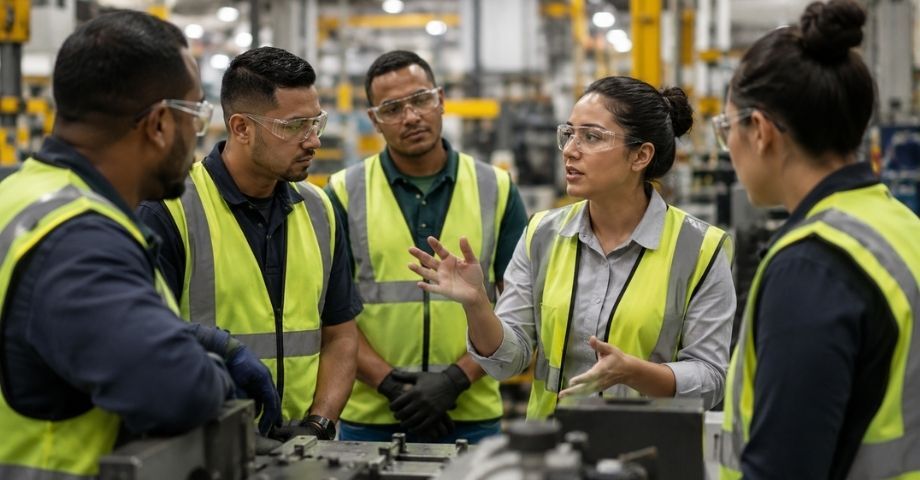
An industrial on-site interpreter is a qualified language professional who works directly on the factory floor to facilitate real-time communication during technical training, safety orientations, and operational audits. Unlike general corporate translators, these specialists understand heavy machinery terminology, personal protective equipment (PPE) protocols, and high-risk factory environment logistics.
During a recent plant rollout in Washington, a local facility scheduled safety orientations for 48 new hires speaking three different languages. The team tried using a single bilingual floor manager to translate. The result? Total logistical gridlock. Production staggered because the manager spent his entire morning repeating instructions instead of supervising the line. Bringing in dedicated in-person interpreters solved the bottleneck, allowing the shift manager to focus on production targets.
Can OSHA Fine Employers for Language Barriers?
Yes, OSHA can issue severe financial penalties to employers who fail to provide safety instructions in a language their workers fully understand. Under the OSHA Act of 1970, safety training is not legally complete unless the worker comprehends the instructions.
According to OSHA’s standard interpretation guidelines, safety training is not legally complete unless the employee comprehends the instructions. The U.S. Department of Labor (DOL) enforces that failing to provide understandable instruction during hazardous tasks like lockout/tagout (LOTO) constitutes a direct violation of the General Duty Clause. In practice, this means that if a plant director relies on visual mimicry or unvetted peers to explain heavy machinery pressure bounds, the district remains fully liable for any resulting workplace injuries and subsequent compliance fines.
Consider these regulatory pillars:
- The General Duty Clause: Section 5(a)(1) mandates a workplace free from recognized hazards. Delivering complex high-voltage instructions to a worker who cannot read the warning labels is a direct violation.
- National Origin Protection: According to the U.S. Department of Labor (DOL) Title VI guidance, failing to provide meaningful language access in federally assisted programs constitutes national-origin discrimination.
- The Financial Impact: Workplace injuries due to communication gaps cost American industries billions annually. The National Safety Council (NSC) reports that clear safety training directly mitigates worker compensation claims and equipment damage downtime.
Should Bilingual Supervisors Interpret Safety Training?
No, bilingual supervisors should not interpret formal safety training unless they are explicitly qualified in technical bi-directional interpretation and industrial compliance ethics. Fluency in a language does not guarantee the ability to translate specialized hazard metrics accurately.
An industry-standard example of this operational risk occurs when facilities scale production lines rapidly. For instance, when an industrial site introduces complex hydraulic machinery manuals, asking a bilingual line supervisor to translate technical pressure bounds instead of using a certified interpreter introduces critical friction. If a precise mechanical tolerance or an OSHA safety constraint is omitted during a verbal floor translation, the facility faces a compounding bottleneck: catastrophic machinery failure, immediate line downtime, and strict emergency repair overhead that breaks the monthly shipping targets.
Choosing Your Modality: On-Site vs. VRI vs. OPI
Manufacturing plants should select their language modality based on the physical mobility required and the complexity of the technical training module. A one-size-fits-all approach leads to either bloated budgets or dangerous communication gaps.
How Factories Organize On-Site Sourcing Without Downtime
Factories can eliminate interpreter scheduling conflicts by integrating professional language networks directly into their master shift calendars. Sourcing standalone agency contractors for individual requests leaves lines vulnerable during sudden shift rotations.
Our teams coordinate local language professionals across primary industrial zones, including Seattle, WA, Los Angeles, CA, and Orange County, CA.. By analyzing the historical shift schedules and dialect footprints of local workforces, management can secure dedicated language coverage during high-volume onboarding windows. This structural planning allows human resources to project clear training timelines, eliminating the administrative friction of single, last-minute agency requests without delaying product shipping dates.
Practical Floor Guidelines for Plant Supervisors
To maintain maximum line efficiency during a bilingual shift, operations directors should establish uniform communication workflows:
- Keep Technical Manuals Handy: Share specific equipment acronyms and safety labels with the interpreter five to ten minutes before the floor walk begins.
- Talk to the Workforce, Not the Linguist: Maintain direct eye contact with your employees. Give operational commands directly rather than saying, "Tell them to look at the gauge."
- Log Vetted Systems: Ensure your administrative office links directly with experienced teams specializing in industrial interpretation support, technical document translation, and plant asset localization solutions.
To discover more about coordinating language compliance across multi-shift networks, explore our library of manufacturing guides, including our deep-dives on business translation best practices, localization solutions for heavy industry, and our core industrial services directory.