
Language access budgets are tight heading into 2027, yet translation backlogs across hospitals, school districts, and city agencies keep growing. At the same time, aggressive sales pitches around standalone AI tools have muddied the water on what is actually safe—and legal—in regulated settings.
Key Takeaways: AI Translation & Human Review in 2027
- Hybrid applies to documents, not live sessions: AI-assisted workflows pair controlled translation engines and Translation Memories (TMs) with line-by-line review by qualified linguists. Live interpreting (OPI, VRI, and on-site) remains 100% human.
- Route documents by risk: High-volume, repetitive files—like parent notices, handbooks, and standard IEP templates—are strong candidates for AI + Human Review (AIR). High-liability records like clinical evaluations, court orders, and due process files should stay in 100% human workflows.
- Compliance depends on human oversight and data controls: Under Section 1557, Title VI, HIPAA, and FERPA, teams must verify how vendor tools handle protected data and ensure qualified human review whenever accuracy affects rights, benefits, or meaningful access.
- Proven backlog relief: Paired with shared glossaries and qualified educational linguists, structured AIR workflows can cut turnaround times by 25%–50% and reduce costs by roughly 25% on high-volume written surges.
Sending raw machine translation to patients, parents, or residents invites clinical errors, audit findings, and privacy complaints. On the other hand, running every routine administrative notice through a slow, manual workflow drains budgets and delays delivery. Knowing when to use AI translation with human review versus 100% human services lets procurement and compliance teams clear backlogs without cutting corners.
1. Written Translation vs. Live Interpreting
The biggest source of confusion in 2027 RFPs is lumping written translation and live interpreting into the same technology bucket. They require completely different rules:
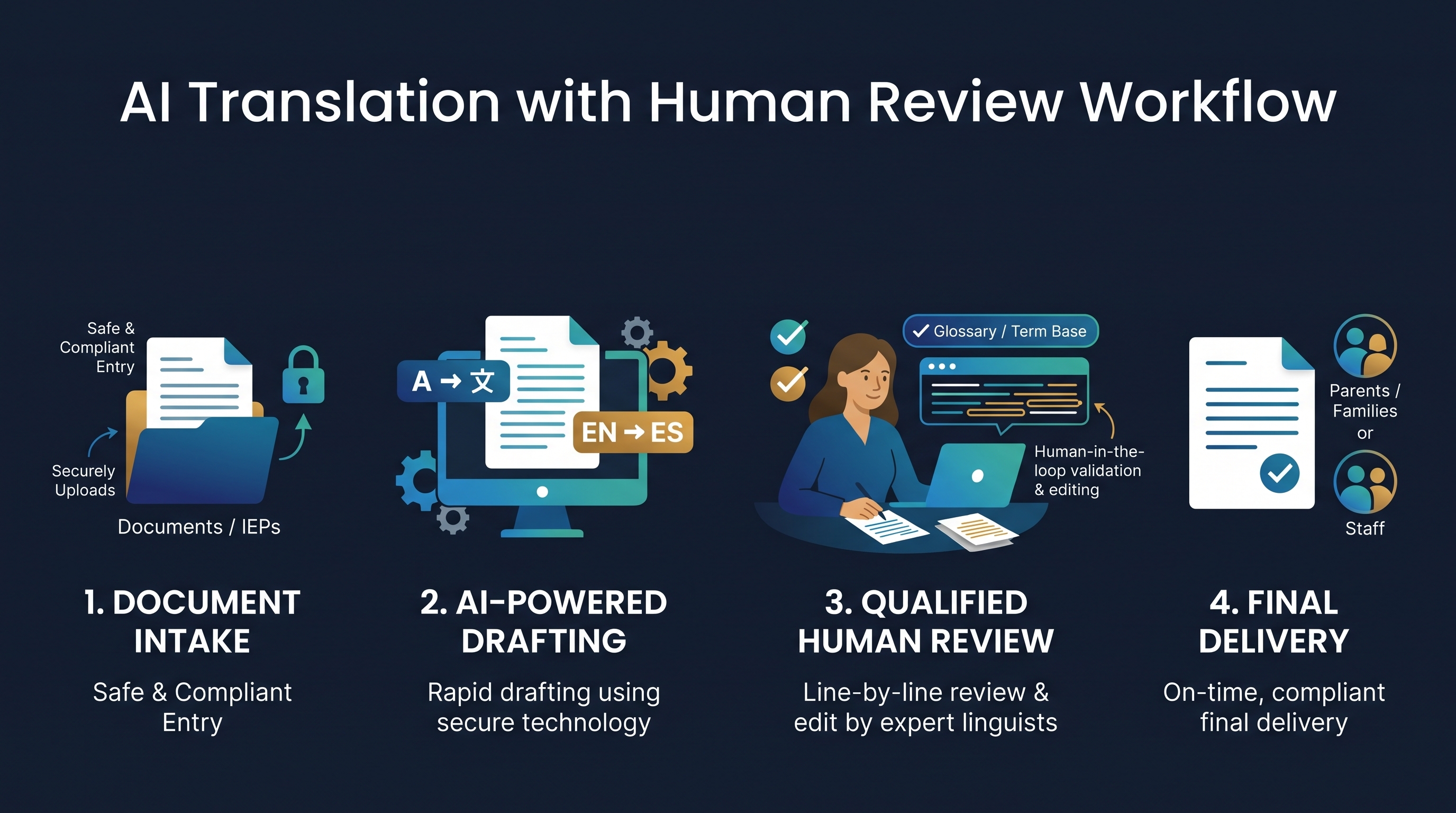
- Written Translation (Where Hybrid Workflows Fit): An AI + Human Review (AIR) workflow uses private, domain-trained translation engines and Translation Memories (TMs) to draft repetitive text, followed by line-by-line post-editing from qualified linguists. Software speeds up formatting and recurring phrasing; human specialists verify legal, medical, or educational accuracy before anything goes out the door.
- Live Interpreting (Always 100% Human): Over-the-Phone Interpreting (OPI), Video Remote Interpreting (VRI), and on-site appointments rely strictly on qualified or certified human interpreters. In exam rooms, courtrooms, and IEP meetings, technology is the scheduling and connection tool—never an automated voice replacing a human interpreter.
2. What Federal Rules Actually Require
Before signing off on any AI-assisted translation workflow, compliance officers need to check how it aligns with four core frameworks:
- Healthcare (Section 1557 & HIPAA): Under Section 1557 of the Affordable Care Act, , covered health programs must provide meaningful language access. When machine translation is used for critical documents, a qualified human translator must review the output when accuracy is essential, when the source text contains complex, non-literal, or technical language, or when the information affects an individual's rights, benefits, or meaningful access. Any vendor handling Protected Health Information (PHI) must also meet HIPAA privacy and security rules, including appropriate safeguards and Business Associate Agreements where applicable.
- K-12 Education (IDEA & FERPA): Under the Individuals with Disabilities Education Act (IDEA), school districts must deliver certain parent notices in the family's native language or other mode of communication, subject to specific procedural notice and timing requirements. Meanwhile, FERPA student privacy rules restrict disclosing personally identifiable information from student records without consent unless an exception applies. Districts should confirm that translation vendors operate under approved agreements with institutional control and strict limits on data use and redisclosure.
- Public Sector & Courts (Title VI): Agencies receiving federal financial assistance must take reasonable steps under Title VI of the Civil Rights Act of 1964 to provide meaningful access based on the surrounding circumstances. Documented quality controls and human review help prevent costly errors in vital public notices. For broader guidance on structuring multi-department contracts, see our 2027 language access planning guide.
3. Decision Matrix: AIR Workflows vs. 100% Human Translation
Not every file carries the same clinical, legal, or linguistic risk. For high-liability records, organizations should consider 100% human translation workflows based on risk, accuracy, and confidentiality needs, while using AIR to move structured, high-volume content faster:
How This Works in Practice: Clearing K-12 IEP Backlogs
When school districts tighten budgets or ask internal bilingual staff to absorb written translation on top of their day jobs, 20- to 30-page Individualized Education Program (IEP) packets pile up fast.
A major urban school district in Southern California serving over 45,000 K-12 students hit this exact wall—facing an 80%+ drop in conventional translation capacity after budget shifts and a growing backlog of Spanish IEPs. By moving those structured packets into a tailored AIR (AI + Human Review) workflow backed by K-12 glossaries, controlled translation environments, and line-by-line review from qualified educational linguists, the district saw:
- ~25% budget savings compared to conventional manual translation.
- 25%–50% faster turnaround on multi-page Spanish IEP packets.
- 100% on-time delivery across scheduled deadlines, freeing bilingual staff to focus on students and families in person.
For more on managing special education timelines and interpreting support, read our K-12 language access compliance guide for IEPs or explore our education language access services.
4. Five Questions to Ask Vendors About AI in 2027 RFPs
When vendors pitch AI features in upcoming bids, ask for written answers to five practical questions:
- Who reviews AI-assisted drafts? Confirm that post-editing is handled by qualified subject-matter linguists—not unvetted crowd workers—especially for healthcare language access programs and government language access solutions.
- What privacy and data-use controls protect our files? Verify contractually that client records are processed under documented security and data-use controls designed to prevent unauthorized access, disclosure, or external model training.
- Who owns the Translation Memories (TMs) and glossaries? Make sure your organization retains rights to approved terminology bases so recurring updates get faster and cheaper over time.
- How do you keep translation automation separate from live interpreting? Confirm that OPI, VRI, and on-site sessions use credentialed human interpreters only—a distinction we cover in detail in our guides on Section 1557 VRI vs. on-site interpreters and government and court language access compliance.
- How are high-risk files routed at intake? Look for clear triage rules that send clinical evaluations, legal filings, and low-incidence languages straight to 100% human workflows.
You can use our Language Procurement Checklist (PDF) to score vendor responses side by side.
Next Steps for Your 2027 Document Workflows
You do not have to choose between unreviewed machine output and months-long translation backlogs. Pairing controlled translation engines with qualified human linguists gives regulated teams measurable budget and turnaround relief while keeping high-stakes communications protected.
Talk with Language Network to see which document types in your department fit an AIR workflow or to request a sample review from our solutions team.