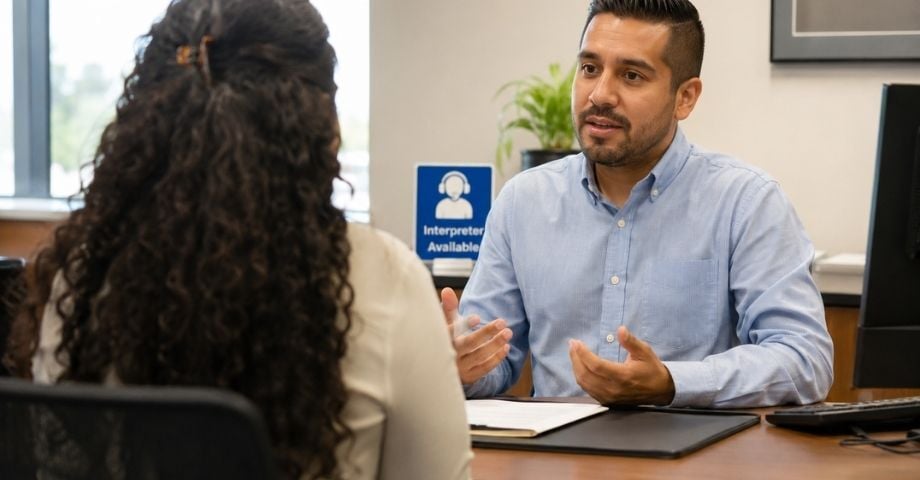
Executive Summary: A city employee answers the phone. The caller speaks only Vietnamese. Without an interpreter, the resident cannot understand emergency evacuation instructions during a sudden wildfire. This is not a hypothetical scenario—it is the exact gap civil rights laws were designed to close. Discover how public organizations and local governments can build, manage, and audit a Language Access Plan (LAP) that satisfies Title VI requirements, aligns with Washington House Bill 2475, and prevents federal civil rights complaints.
Why Language Access Matters in Real Life
A city employee answers the phone. The caller speaks only Vietnamese.
Without an interpreter on the line, the resident cannot understand evacuation instructions during a sudden wildfire or local public safety emergency.
This scenario happens across Washington every single day.
Municipalities, county departments, and regional public organizations serve rapidly diversifying communities. When limited-English-speaking residents cannot access emergency notifications, housing forms, or public hearings, the issue goes far beyond customer service—it becomes a critical operational and legal risk.
💡 Key Recommendation Do not wait for a resident complaint or a civil rights audit to review your communication infrastructure. Proactive language access protects both your community and your municipal funding.
What is Title VI Compliance?
In short: Title VI requires any government agency receiving federal funds to provide meaningful language access for Limited English Proficient (LEP) individuals. Failure to do so may constitute national origin discrimination.
Under Title VI of the Civil Rights Act of 1964, no person in the United States can be excluded from participating in, or denied the benefits of, any program receiving federal financial assistance based on race, color, or national origin.
Enforcement authorities, led by the U.S. Department of Justice Civil Rights Division, treat language barriers as directly linked to national origin discrimination.
Our public-sector clients frequently ask if small federal sub-grants trigger these rules. The answer is yes. Whether a public entity receives direct federal funding or pass-through grants through state programs, the entire operating department must comply.
Recent Data: The Reality for Washington Local Governments
Navigating compliance requires understanding the demographic and operational shifts across local jurisdictions:
- 21%+ Non-English Speakers: According to U.S. Census Bureau data compiled by the Washington State OFM, over 21% of households in Washington speak a language other than English at home, accounting for more than 700,000 Limited English Proficient (LEP) residents statewide.
- DOJ Enforcement Spike: Federal enforcement actions monitored by the U.S. Department of Justice Civil Rights Division have surged nationwide as federal auditors scrutinize municipal compliance with Title VI mandates.
- 15–25% Error Rates in AI Captions: Industry testing on live speech recognition software published by AssemblyAI Speech-to-Text Benchmarks confirms that automated captions yield 15% to 25% error rates during multi-speaker proceedings and technical dialogues.
- Severe Interpreter Shortages: Labor projections from the U.S. Bureau of Labor Statistics report an ongoing national shortage of certified human interpreters, making ad-hoc internal staffing unsustainable for growing public departments.
Need help evaluating your current Language Access Plan? See how Language Network supports Washington public organizations with tailored compliance tools.
Washington State Mandates: The Impact of HB 2475
While federal regulations set the baseline, state lawmakers introduced Washington HB 2475 to establish uniform guidelines across state agencies and local jurisdictions.
The law directs public organizations to ensure accessible communication across six core channels:
- In-person public counters and official hearings.
- Telephonic dispatch and call networks.
- Virtual city council meetings and public workshops.
- Digital resident portals and public websites.
- Paper forms, vital notices, and application packets.
- Recorded public service announcements and media.
To learn more about state guidelines, review our Washington HB 2475 Compliance Guide.
The DOJ Four-Factor Analysis: Building an Auditable Plan
One of the most common mistakes we see in local governments is relying on unwritten, informal processes. Federal auditors require a written, auditable Language Access Plan (LAP).
The Department of Justice expects agencies to structure their plan around a four-factor assessment:
- Factor 1: Proportion of LEP Residents. Evaluate local Census metrics and school district data to identify primary language needs within your jurisdiction.
- Factor 2: Contact Frequency. Track daily constituent interactions across public counters, emergency dispatch, and online portals.
- Factor 3: Importance of the Service. Emergency response, public safety, and housing vouchers require immediate, certified language assistance compared to optional public events.
- Factor 4: Resource Balance. While budget limits exist, federal guidelines require departments to implement efficient, scalable solutions rather than denying access.
For step-by-step guidance on policy frameworks, consult our guide on Language Access Plans for City Governments.
Common Mistakes vs. Legal Risks
Relying on ad-hoc language methods introduces severe legal and operational exposure. The table below outlines common department pitfalls and their consequences:
|
Common Agency Mistake |
Operational & Legal Risk |
|
Using family members or minor children to interpret |
Formal DOJ complaint, severe privacy violations, and miscommunicated facts. |
|
Relying on unvetted machine translation for public forms |
Incorrect public instructions, legal errors, and lost constituent trust. |
|
Failing to log interpreter usage across departments |
Federal audit failure and inability to prove Title VI compliance. |
|
Providing no translated vital application forms |
National origin discrimination claims and potential loss of federal sub-grants. |
|
Using auto-generated AI captions for Deaf residents |
ADA Title II violations due to high error rates and lack of true ASL structure. |
Building a Flexible, Multimodal Language Access Infrastructure
Today, most municipalities rely on a combination of on-site interpreters, phone interpreting, video interpreting, and ASL services to meet compliance requirements while controlling costs.
No single service channel handles every public scenario:
- On-Site Interpretation: Essential for formal council meetings, legal proceedings, and sensitive public health encounters. Learn more about our On-Site Interpretation Services.
- Over-the-Phone Interpreting (OPI): Provides instant, 24/7/365 access in 200+ languages for 911 dispatch and high-volume front counters.
- Video Remote Interpreting (VRI): Delivers visual communication on demand for virtual public hearings and scheduled appointments.
- ASL & Accessibility: Ensures complete ADA compliance for Deaf and hard-of-hearing residents through certified Sign Language professionals. Read our comparison on ASL Interpreting vs. AI Captions.
Final Recommendation: Maintaining Long-Term Compliance
Whether your organization is updating an existing Language Access Plan or building one from scratch, regular audits, staff training, and reliable access to qualified interpreters are essential to maintaining Title VI compliance.
If you would like an independent review of your current language access program, our public-sector specialists at Language Network can help identify compliance gaps and recommend practical improvements tailored to your jurisdiction.