
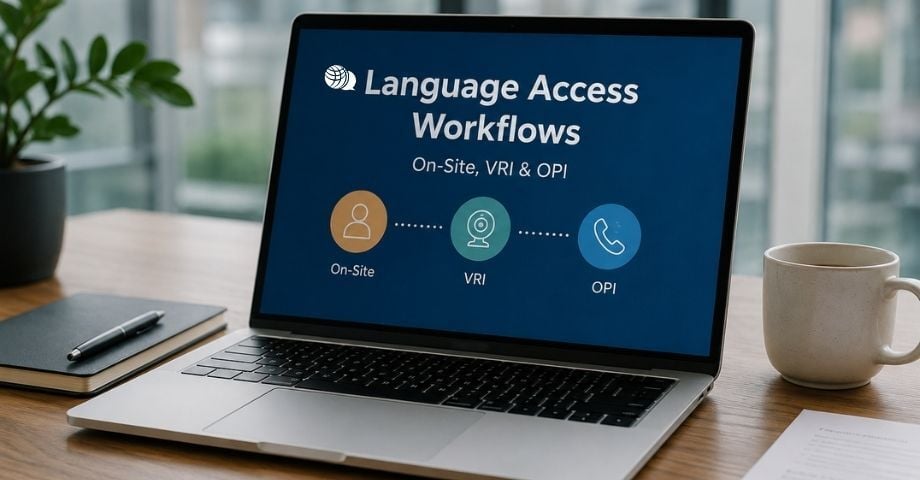
Executive Summary: Enterprise organizations frequently overpay for language access by treating interpreting as isolated vendor requests rather than a centralized operational workflow. Managing multiple vendors across fragmented department budgets leads to duplicate scheduling overhead and inflated Total Cost of Ownership (TCO). Discover how strategic sourcing teams and procurement directors can optimize language logistics by balancing On-Site, Video Remote (VRI), and Over-the-Phone (OPI) modalities to maximize ROI without compromising service quality.
Storytelling: The $400 Meeting That Cost $2,400
Consider this common enterprise scenario: A multi-state healthcare and corporate enterprise prepares for a high-stakes executive board meeting and quarterly performance review.
The HR department hires an independent agency to bring two on-site Spanish interpreters for a 45-minute presentation. Simultaneously, the legal department contracts a second vendor to provide on-site interpreters for a concurrent compliance review across the hall. Neither department communicates with procurement, resulting in separate travel stipends, minimum hour guarantees, and duplicate administrative fees.
The direct cost of the interpreting services was $400. The actual cost to the enterprise—after accounting for travel stipends, 2-hour minimums, and fragmented vendor processing—was $2,400.
This operational disconnect occurs in enterprise organizations every single day.
When procurement teams allow individual departments to manage interpreting on an ad-hoc basis, language access ceases to be a strategic capability and becomes an unmonitored financial leak.
Why Enterprise Language Access Requires a Logistics Strategy
Enterprise language logistics involves centralizing vendor management, scheduling workflows, and budgeting under a unified framework. Rather than defaulting to expensive on-site deployments for every scenario, organizations optimize Total Cost of Ownership (TCO) by matching interpreting modalities to specific operational requirements.
In a global enterprise landscape, workforce accessibility and multilingual customer engagements are non-negotiable. However, most organizations handle interpreting reactively.
Procurement directors frequently report that language services represent one of the most fragmented spend categories in their supply chain. HR, legal, customer operations, and facilities management often procure language services independently, leading to:
- Siloed Contracts: Multiple active contracts operating under varying rates and service level agreements (SLAs).
- Off-Contract Spend: Unvetted credit card purchases for translation apps or temporary agencies that expose the brand to compliance and confidentiality risks.
- Redundant Minimums: Paying 2-hour minimum fees ($150–$300+ per occurrence) for on-site interpreters for interactions that could be handled via remote channels in minutes for under $30.
According to research from operational management frameworks highlighted by Harvard Business Review Supply Chain Insights, centralizing fragmented vendor pools is the single most effective lever for reducing operational waste without reducing service output.
The Real Cost of Fragmented Language Vendors
When strategic sourcing managers audit enterprise language spend, the line-item costs of interpreting hours are rarely the primary driver of budget overruns. The true cost lies in administrative inefficiency.
Standard procurement studies published by McKinsey & Company Operations Insights indicate that managing fragmented supplier lists and manual invoice approvals increases departmental handling costs significantly per transaction, creating hidden operational drag across accounting and HR departments.
Key Quantitative Metrics: The Language Network Benchmark
To understand where budget leakage occurs, strategic sourcing managers should evaluate the operational benchmarks powered by Language Network's enterprise infrastructure:
- Instant OPI/VRI Response Speed: Average connection times of 9–12 seconds for Spanish calls and 16–23 seconds for all other languages across our 24/7 on-demand network. Connection speeds remain identical during night hours, weekends, or emergency requests.
- On-Site Booking Lead Time: Submitting requests 5–7 business days in advance guarantees maximum physical coverage and match rate for specialized linguists.
- 100% Certified Healthcare Linguists: 100% of spoken-language interpreters assigned to medical projects hold national credentials (NBCMI, CCHI, DSHS) , while ASL interpreters hold national RID or BEI certifications.
- Secure Scheduling Audit: 100% encrypted data transmission (HTTPS/TLS) and role-based access control managed via the Interpreter Intelligence (II) portal, ensuring full HIPAA and PHI compliance.
💡Curious how much fragmented language procurement is costing your organization? Request a free language spend assessment with our strategic procurement team to uncover hidden costs and consolidate your workflows.
.png?width=920&height=280&name=conference-interpreting-banner%20(1).png)
Industry Benchmarks & Enterprise Market Trends
Understanding industry benchmarks helps procurement leaders structure competitive contracts, execute language spend optimization, and evaluate vendor performance. Key data points shaping enterprise language strategy include:
- Growth in Remote Delivery: Market analysis from the Nimdzi 2025 Interpreting Index highlights that remote modalities (VRI and OPI) represent a rapidly growing share of total commercial interpreting spend worldwide, driven by hybrid workforce models.
- Technology & Workflow Automation: Research from the Slator Interpreting Technology & AI Report emphasizes that enterprise buyers increasingly prioritize vendors offering automated scheduling integration, single sign-on (SSO), and real-time portal reporting.
- Procurement Best Practices: Industry frameworks from the Association of Language Companies (ALC) show that vendor consolidation in language services reduces supplier management complexity and administrative overhead.
- Regulatory Compliance & Accessibility: Federal directives under U.S. Department of Health & Human Services Section 1557 Guidance and U.S. Department of Justice ADA Guidance require organizations receiving federal funds to maintain documented, qualified language access frameworks across all modalities.
If your organization also manages written documentation, user manuals, or global marketing assets alongside interpreting, explore how our AI Translation with Human Review and localized Marketing Content Localization solutions maintain global brand consistency while cutting translation costs.
Choosing the Right Interpreting Modality: On-Site vs. VRI vs. OPI
To maximize ROI, interpreting procurement leaders must evaluate the core operational tradeoffs between On-Site, Video Remote Interpreting (VRI), and Over-the-Phone Interpreting (OPI).
Extended Modality Comparison Matrix for Enterprise Sourcing
|
Evaluation Factor |
On-Site Interpretation |
Video Remote Interpreting (VRI) |
Over-the-Phone Interpreting (OPI) |
|
Cost Structure |
Hourly rate + travel stipends + 2-hour minimum guarantee |
Per-minute or scheduled hourly blocks; zero travel fees |
Strictly per-minute usage with zero minimum hour commitments |
|
Response Time |
5–7 business days advance notice recommended |
On-demand (< 12–23 secs average) |
Immediate on-demand connection (< 10–12 secs for core languages) |
|
Best For |
High-stakes litigation, arbitration, multi-day conferences, complex clinical reviews |
Virtual board meetings, scheduled HR interviews, telehealth, Deaf/Hard-of-Hearing access |
Call centers, customer service desks, emergency dispatch, front-desk check-ins |
|
Relative ROI |
High value for critical events; low ROI for short, routine meetings |
High ROI for scheduled remote work, virtual meetings, and visual support |
Maximum ROI for high-frequency, short-duration transactional communications |
|
Availability |
Dependent on regional linguist coverage |
24/7/365 global access (identical speed on nights/weekends) |
24/7/365 instant global access across 240+ languages |
|
Compliance Readiness |
Meets strict courtroom and clinical in-person standards |
100% HIPAA compliant with encrypted video channels |
Full HIPAA & Title VI compliant for audio interactions |
|
Visual Interaction |
Full body language, physical presence, and spatial room dynamics |
High-definition video for facial expressions and Sign Language (ASL) |
Audio only |
Strategic Modality Allocation
- Deploy On-Site Interpretation when physical presence directly impacts outcome accuracy or legal risk, such as formal court hearings or multi-day executive events. Learn how we manage certified local linguists via our On-Site Interpretation Services.
- Deploy Video Remote Interpreting (VRI) for virtual meetings requiring visual context or Sign Language access. Discover our Video Remote Interpreting (VRI) Platform and dedicated ASL Interpreting Services.
- Deploy Over-the-Phone Interpreting (OPI) for instant, high-volume verbal transactions. Learn more about our high-availability Over-the-Phone Interpreting (OPI) Services.
To review real-world enterprise implementations and case studies, read our Client Success Stories or explore our broader Business & Corporate Solutions.
Building a Centralized Language Access Workflow
Transitioning from fragmented purchasing to a streamlined enterprise language strategy requires an integrated operational flow:
Enterprise Language Access Optimization Checklist
Use this checklist to audit your procurement team's readiness:
- Centralized Portal Access: Manage all requests through a secure scheduling portal (Interpreter Intelligence) with role-based access and full audit trails.
- Dedicated Account Management: Ensure your organization has a dedicated point of contact to oversee interpretation logistics and maintain communication.
- Preferred Interpreter Pools: Build a dedicated pool of certified ASL and spoken-language linguists already familiar with your company's specialized terminology.
- On-Site Cancellation Protocol: Confirm your provider maintains a structured emergency replacement process with automatic status tracking (e.g., "Open – Coverage Needed").
- SLA & Compliance Verification: Require 100% vetting verification for healthcare projects, HIPAA signed acknowledgments, and client-specific vaccination tracking.
Regional Execution: Supporting Enterprise Hubs
Executing a centralized language logistics plan requires a partner with both global reach and local infrastructure. Major enterprise hubs—such as the Pacific Northwest and Southern California—demand specialized linguists trained in technology, legal, and biomedical terminology.
Language Network supports enterprise operations across key business regions. Learn more about our local infrastructure on our Seattle, WA Language Services Page and our Riverside, CA Language Services Page.
Final Recommendation: Designing a Scalable Language Strategy
Whether your organization is auditing current vendor contracts or building a centralized language access workflow from scratch, regular spend reviews, clear modality triage, and vendor consolidation are essential to controlling costs.
If you would like an independent evaluation of your organization's language logistics, our specialists at Language Network can evaluate your current workflows and recommend the optimal mix of On-Site, VRI, and OPI services.
Ready to optimize your language service procurement? Contact our sales team today to schedule an enterprise language strategy consultation.